Kosmos Society

An online community for classical studies

Recent

Book Club/ January 2026

On January 28, 2026 at 1:00 p.m EST, Kosmos Book Club will gather to discuss three articles by Edith Hall “Aristotle’s the Theory of Catharsis in its Historical and Social Context” “The Sociology of Athenian Tragedy” “Tragedy Personified” The discussion would start on the Forums and continue on the day of the gathering. The link would be posted on the Forums. Happy readings! Read more

The Ancient Greek Hero in 24 Hours | Gallery: Part 6

The Ancient Greek Hero in 24 Hours[1] is based on a course that Professor Gregory Nagy has been teaching at Harvard University since the late 1970s. The book discusses selected readings of texts, all translated from the original Greek into English. The texts include the Homeric Iliad and Odyssey; selected Homeric Hymns; the Hesiodic Theogony and Works and Days; selected songs of Sappho and Pindar; selections from the Histories of Herodotus;… Read more

Food and drink | Part 1: Homer and Hesiod

At this time of year our thoughts often turn to food and drink, so we start our exploration of the topic in Homeric and Hesiodic poetry. Where does their food come from? What kinds of foods does the poetry represent? How is it prepared and served? There is evidence for herd animals being reared. For example, in the Odyssey Eumaios mentions the flocks on Ithaca and its neighbors: There are… Read more

Divine Gifts

Pierre Judet de La Combe in his book Homère (2017) evokes the gifts of the gods which are ambiguous and double-edged. One example he mentions is Demodokos: 62 The herald came near, bringing with him a singer, very trusted, 63 whom the Muse loved exceedingly. She gave him both a good thing and a bad thing. 64 For she took away from him his eyes but gave him the sweetness… Read more

Open House | Looking Backward: Through the Lens of Odyssey 24, with Gregory Nagy

We were pleased to welcome Gregory Nagy, the Francis Jones Professor of Classical Greek Literature and Professor of Comparative Literature at Harvard University, who joined members of the Kosmos Society on November 21 for an Open House discussion on “Looking Backward: Through the Lens of Odyssey 24.” You can view the recording on the Kosmos Society YouTube channel, or in the frame below. Odyssey 24 is the final “book” of… Read more

Core Vocab: kamatos

This time the Core Vocab term—taken from terms listed in H24H[1] and tracked in the associated Sourcebook[2]— is kamatos [κάματος] which Gregory Nagy glosses as ‘ordeal, labor, pain’. This seems to convey a similar range of meanings to another Core Vocab term, ponos [πόνος], also glossed as ‘ordeal, labor, pain’ which was the subject of a previous blog article. So I looked initially at the dictionary entries to see what… Read more

Open House | Rites of Passage and the Making of Achilles in Statius’ Achilleid, with Patricia Hatcher

We were pleased to welcome Patricia Hatcher, CUNY Graduate Center, to join members of the Kosmos Society for an Open House discussion on Rites of Passage and the Making of Achilles in Statius’ Achilleid. This talk applies anthropological ritual theory to Statius’ Achilleid to reinterpret Achilles’ early life as a series of rites of passage. Drawing on Arnold van Gennep’s tripartite model and Victor Turner’s concept of liminality, the discussion… Read more

The Classic Ship | Part 3: The Battle of Salamis

In the last days of September of the year 480 BCE, King Xerxes proceeded to Athens, after having had his victory at Thermopylae. Also his naval forces moved southward for the final stroke. Among the Persian naval contingent were 120 triremes from Thrace, 100 ships from Ionia, 60 ships from Aeolia including Lesbos and Samos, and an unspecified number of ships from the Greek islands, including the Cyclades, and lastly,… Read more

Performance of epic | Part 2: Rhapsodes

Victorious poet (inscribed “He is beautiful”) reciting (“As once in Tiryns…”) In Part 1 we looked at the role of aoidoi as depicted within epic poetry itself. Now we turn to later sources in which the word rhapsode comes into use. In that post, we touched on the performance of Achilles and Patroklos in relay. Gregory Nagy comments: 8§28…Homeric poetry was performed at the Panathenaia by rhapsōidoi, ‘rhapsodes’ … The… Read more

Pindar, Second Nemean Epinikion

  A translation and notes by Jack Vaughan For Timodemos of Archarnai, Victor in Pankration Much as Homerid singers often begin their weaving of songs with a prelude honoring Zeus, this man, too, for a start has received an installment of a victory-studded career in the sacred contests in the much-celebrated hallowed precinct of Nemean Zeus. It still behooves him, the son of Timonoos, if his life’s time, guided straight according to the ways of his fathers, has been given as an adornment to… Read more

Connect

EXPLORE

Library

Text Library

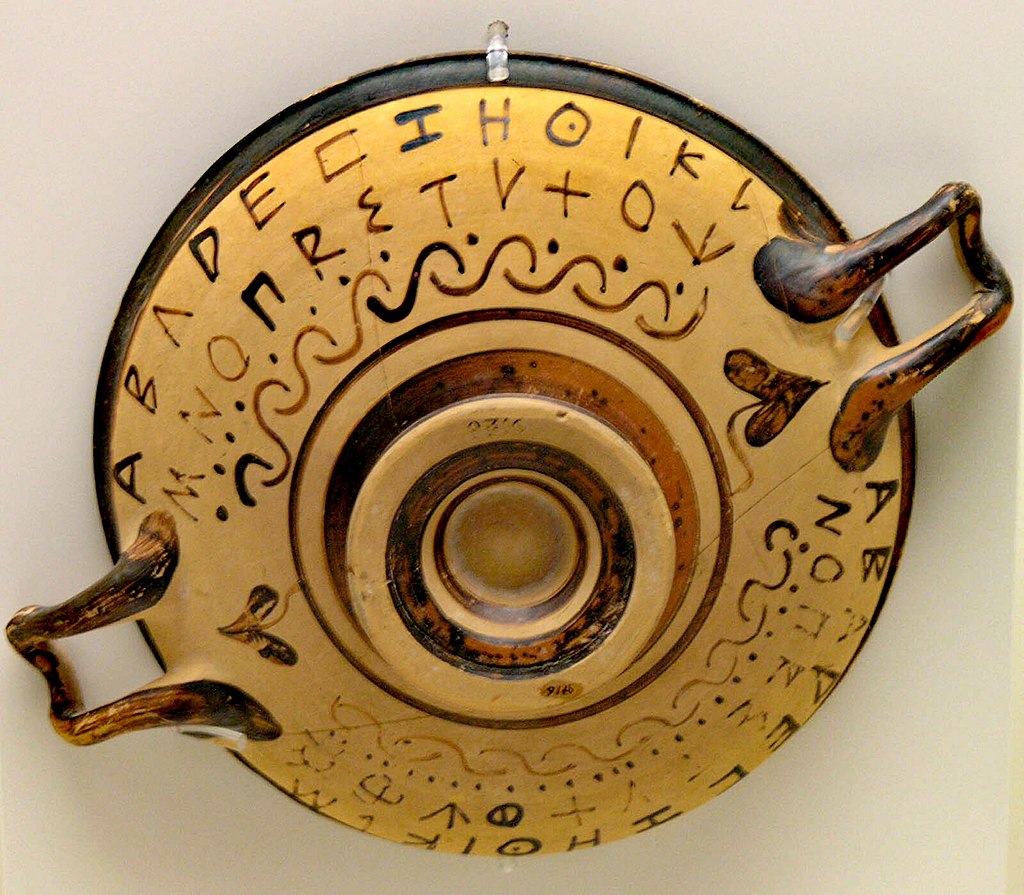
Greek alphabet on cup

Ancient Greek

Collage of some Open House guests

Open House


Join the Kosmos Society

Apply

Support the Kosmos Society

Donate